The 95% Router: Why AI Triage Beats the Human Sort
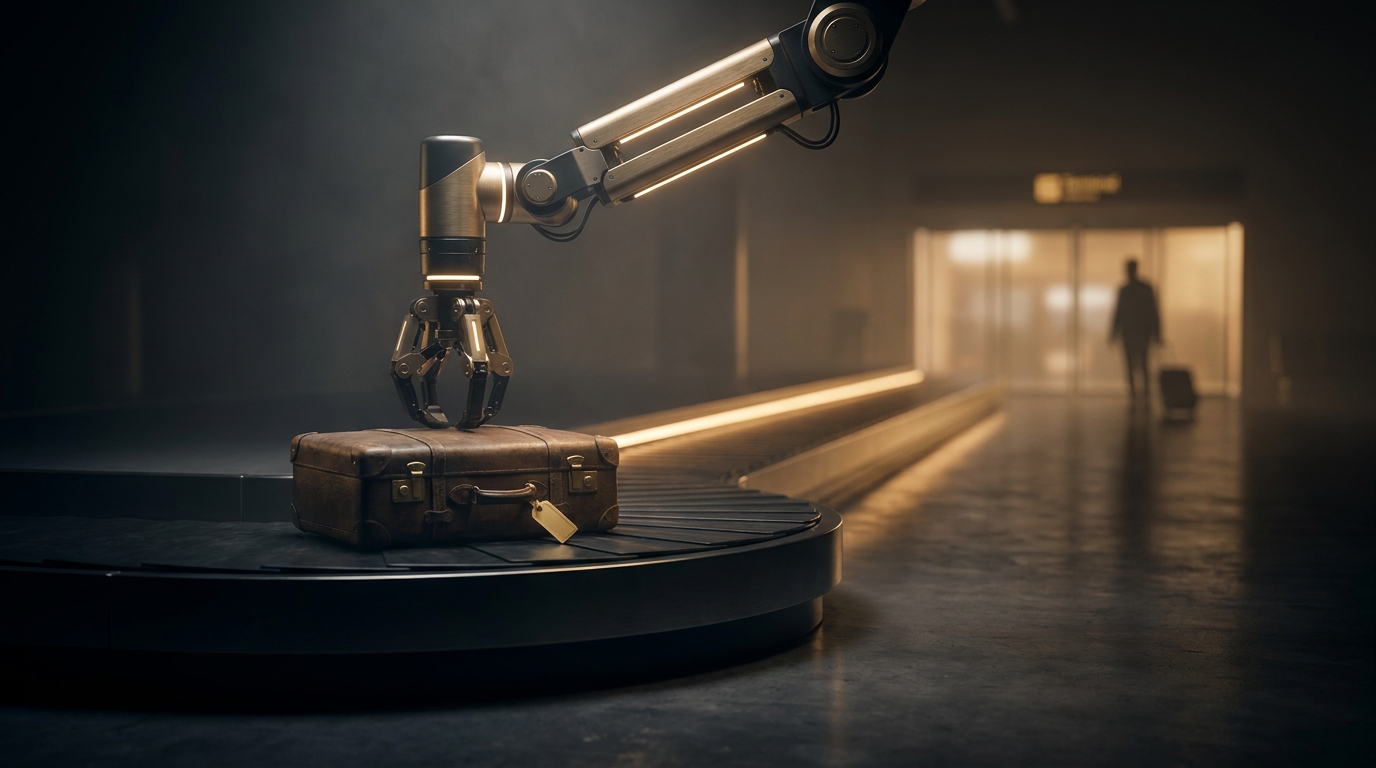
There's a ticket somewhere in every large support org that's been to four queues and solved nothing. It started in billing, got bounced to technical, sat overnight, landed in account management by mistake, and is now headed back toward billing with a customer who has stopped being polite. Nobody owns it. Everybody has touched it. It is the support equivalent of a piece of lost luggage circling a carousel after the flight has long since emptied.
That ticket is not a freak event. It's the system working exactly as designed.
The hidden tax on the front door
Triage looks like the cheap part of support. A glance, a category, a queue. It's anything but cheap. Manual triage eats about 40% of an agent's working time (Fini Labs), which means a meaningful slice of the payroll on a support floor goes to deciding where things should go rather than actually fixing them. That's the tax. It's invisible because it's spread across every person and every ticket, a few seconds and a few wrong guesses at a time.
And the guesses are wrong more often than anyone likes to admit. Human agents route correctly about 77% of the time (Fini Labs). Flip that number over and roughly 23% of tickets get sent somewhere they don't belong. Almost a quarter. Each one is a small relay race in the wrong direction, a reassignment, a re-read, a customer waiting while the thing they need passes through hands that can't help them.
What the machine does differently
AI triage reads the ticket, classifies the intent, checks the history, and routes. It hits 95%-plus accuracy on that routing (Fini Labs), which drops misrouting from about 23% down to about 4%. The wandering ticket mostly stops wandering.
Speed is where it gets almost unfair. A manual queue answers a new ticket in four to six hours. The same ticket, sorted by an automated system, gets a first response in under 30 seconds (Fini Labs). The customer who used to wait half a business day now waits less time than it takes to refill a coffee.
This isn't only sorting, either. The better platforms push past triage into actual resolution: 60% to 80% of inbound handled without a human, against 30% to 45% on basic tools (Fini Labs). But resolution is the deep end, and triage is the shallow, safe step you take first. Classifying and routing is low-risk by nature. A wrong category gets corrected. The human stays firmly in the loop, only now they're inheriting a clean, correctly-labeled ticket instead of a mystery.
The math the floor manager actually cares about
Give an agent back the 40% they were spending on the sort, and the day changes shape. Automating triage saves 35% to 45% of agent time (Fini Labs). That time doesn't vanish into a slide deck. It shows up as throughput: roughly 30 to 35 tickets a day per agent climbs to 50 to 60 (Fini Labs). Same headcount. Nearly double the work cleared.
There's a temptation to read that as "fewer agents," and some orgs will. The smarter read is "the agents you have, pointed at the hard problems." Routing is rote. The angry edge case, the judgment call, the customer who needs a person to actually listen: that's where humans are worth their salary, and it's exactly the work that gets crowded out when a third of the day goes to triage.
Proof that it isn't a pitch deck
The numbers hold up in the wild. TrainingPeaks cut average handle time by 73% (Fini Labs). ICICI Bank runs an 80% resolution rate across more than 50 million users (Fini Labs), which is the kind of scale where a few points of routing accuracy translate into whole buildings of saved effort. And the customers notice the difference: CSAT lands at 8.1 out of 10 with AI in the loop, versus 7.2 without (Fini Labs). People can feel the absence of the runaround even when they can't name it.
That last gap is the quiet one. A point of CSAT doesn't sound like much until you remember what it's measuring: the difference between a customer who got helped and one who got handed off. The misrouted ticket is bad for the balance sheet, sure. It's worse for the person on the other end, the one who explained their problem once and is now being asked to explain it again to someone new.
Start where the risk is low
The pitch for full autonomous resolution is loud right now, and it's earned some of the volume. But the orders of operations matter. Triage is the move you make before you make the big ones. It's measurable, it's reversible, it keeps a human watching, and it pays for itself in returned hours almost immediately. An audit that maps where a team's tickets actually pile up, then aims AI at the routing layer first, is how the careful operators are doing it.
The lost-luggage ticket doesn't need a robot to solve it. It needs a robot to read the tag.
Sources: Fini Labs (AI vs human routing accuracy 95%+ vs 77%; misrouting 23% to 4%; time-to-first-response 4-6 hours to under 30 seconds; autonomous resolution 60-80% vs 30-45%; manual triage at ~40% of agent time; time savings 35-45%; throughput 30-35 to 50-60 tickets/day; TrainingPeaks 73% handle-time cut; ICICI Bank 80% resolution at 50M+ users; CSAT 8.1 vs 7.2).