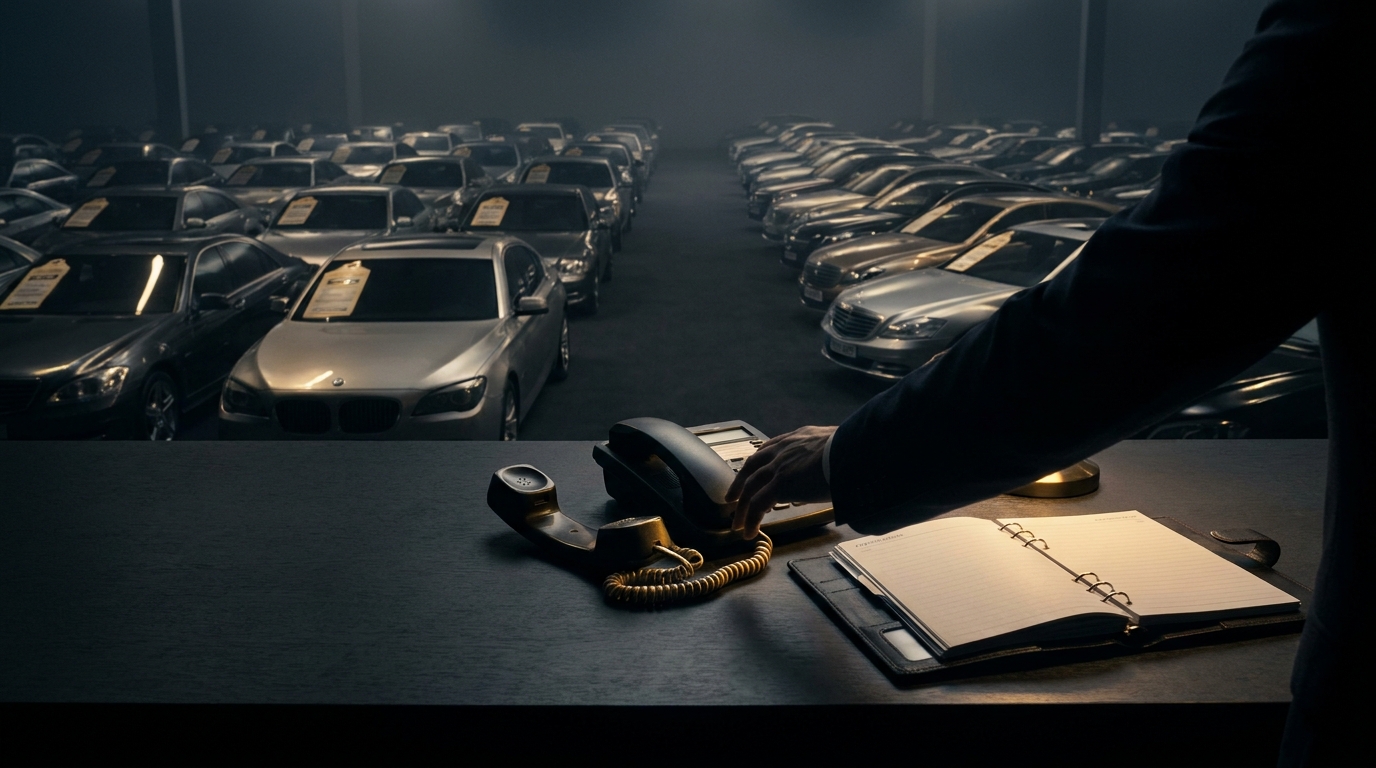
21% of Service Calls Ring Out, and the Service Drive Never Finds Out
Car dealerships are among the most heavily instrumented retail operations in existence. Every unit on the lot has a cost, an age, and a floor-plan interest charge attached to it. Somebody knows, to the dollar, what the slowest-moving vehicle on the back row is doing to the month.
The phone is not instrumented anything like that well, which is odd, because it is where the service department's revenue arrives.
Per Marchex's conversation-intelligence analysis, up to 21% of automotive service customer calls go unanswered, and nearly 20% of calls to dealerships overall are either unanswered or abandoned by the caller. A further 10% of callers abandon during automated routing or voicemail, which is a separate failure and easy to double-count as a success because the phone system technically picked up.
The economics are already known, just not applied
Fixed operations is the part of a dealership that pays the bills between good months. It is repeat, it is high-margin relative to unit sales, and it is scheduled rather than seasonal.
Marchex's own illustrative calculation makes the arithmetic concrete: a service department averaging 158 missed calls a month, against an average repair order around $450, is looking at roughly $853,200 in annual exposure. Treat that as a modeled figure rather than an audited one, since it multiplies an average by a volume. The order of magnitude survives most reasonable adjustments.
There is a documented recovery case in the same research. A Marchex client, in a two-month pilot using conversation intelligence, recovered $1 million in previously missed service revenue. Vendor case study, appropriate skepticism applies. It still describes money that existed, went unclaimed, and was retrievable by measurement alone.
Why this specific failure hides so well
Three structural reasons, all of them boring, which is why the problem persists.
The service drive is a physical queue. Advisors are standing with customers, walking bays, and printing estimates. A ringing phone competes with a person who is already there, and the person who is already there wins. That is not bad service. It is triage under constraint, repeated forty times a day.
The second reason is that a missed call generates no artifact. A missed sales lead sits in the CRM looking accusatory. A missed service call produces a line in a phone log nobody reads and a customer who booked elsewhere. There is no record of the appointment that did not happen.
The third is measurement culture. Dealerships measure what the manufacturer requires and what the DMS reports natively. Call answer rate is usually neither, so it drifts into the category of things everyone assumes are fine.
Where automation actually fits
The instinct is to reach for an AI receptionist. That is one answer, and probably not the first one.
The first move is characterization. Pull a month of call data and answer three questions: what share of inbound calls went unanswered, what share of those were service versus sales, and what share of the answered ones were routine status checks that never needed an advisor at all. Marchex notes that 28% of consumers who call a dealership ultimately purchase a vehicle and 57% of inbound sales-department calls carry purchase intent, so the mix is not evenly valuable and it is worth knowing the split before automating anything.
The second move follows from the answer. "Is my car ready" and "what time do you close" are deflection candidates with essentially no downside. "My check engine light is on and I have a road trip Friday" is an escalation that should reach a human in seconds with context attached. Those are different products, and buying one when the volume was in the other is the standard way these projects disappoint.
The dealership knows exactly what the slowest vehicle on the lot costs it every day. The phone that rang eleven times this morning and stopped is, so far, free.
Sources: Marchex conversation-intelligence analysis of dealership call handling (up to 21% of automotive service customer calls go unanswered; nearly 20% of dealership calls unanswered or abandoned; as many as 10% of callers abandon during automated routing or voicemail; up to 28% of consumers who call a dealership ultimately purchase a vehicle; 57% of inbound sales-department calls carry purchase intent; illustrative modeling of 158 missed monthly service calls against a ~$450 average repair order at roughly $853,200 annually; a client pilot recovering $1 million in previously missed service revenue over two months). Revenue figures are Marchex's modeled or client-reported results, not independently audited.